Hey there,
Ever hopped in your car, pressed the front brake, and felt that weird pulsing through the pedal like you’re pressing a vibrating massage chair by accident? Yeah, that’s the worst. As a front brake rotors supplier, I get emails and calls all the time from folks asking “why are my rotors all jacked up like that?” Most of the time they’re talking about rotors that are “out of round” — not perfectly circular when you spin ’em, so every brake application vibrates like crazy. Today, I’m breaking down exactly what causes that mess, from stuff we see in our supply chain to mistakes that happen way down the line, no fancy jargon, just real talk from someone who deals with brake parts every single day. Front Brake Rotors
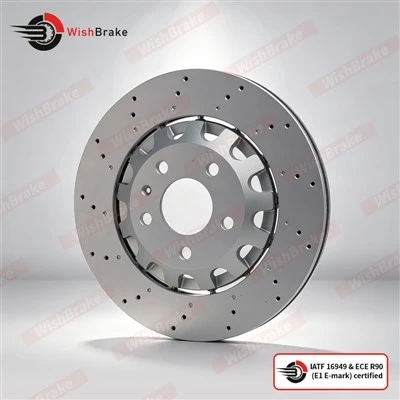
First off, let’s clear up what “out of round” actually means for rotors, because half the time people mix it up with warping. Warping is usually a heat thing, right? Out of round is specifically when the rotor’s not a perfect circle around its center axis. Think of a dinner plate that’s squished a little on one side — spin it, and one edge dips closer to your wheel hub before pulling away. That’s the uneven spin that makes the pedal pulse. Easy enough to spot: if you jack up your car, spin the front wheel by hand, and the gap between the rotor and brake pad changes noticeably all the way around? Bingo, out of round.
Now, the causes. Let’s start with the stuff that happens before a rotor even leaves our warehouse, because even the best parts can get messed up in transit. Wait, not just transit — let’s go back a step to when we make ’em. When we machine rotors, we use a precision lathe to cut the friction surface to a perfect circle. But here’s the thing: if the wheel hub on the car isn’t true (let’s call that hub runout, for short), when you bolt the rotor on, it’s like trying to fit a round peg in a slightly oval hole. We’ve seen this happen a ton when customers take a new rotor off the box and bolt it right on a dirty or bent hub. Hub grime, rust, even a tiny ding in the lug nut studs? That throws the whole alignment off. One of our install tech friends once told me they see 20% of new rotor out-of-round issues from lazy pre-install checks on the hub. That’s a huge number, and it’s totally avoidable.
Next, heat damage — this is the big one that everyone blames, but most people get it wrong. A lot of folks think heavy braking alone twists rotors out of round, and yeah, that plays a part, but it’s usually a specific kind of heat over time. When you brake, friction between the pads and rotor turns kinetic energy into heat — we’re talking 1,000°F+ for race cars, even 300-500°F for your daily commute. Normally, that heat dissipates through the rotor and hub. But if you do a lot of stop-and-go city driving, or hard, repeated stops (like towing a trailer down a hill, or slamming on brakes every time you hit a school zone), you get uneven heat expansion. One part of the rotor gets hotter than the rest, so that spot swells up like a balloon. Then you let off the brakes, and it cools down fast — that same spot shrinks, and over and over, that’s what warps the rotor. Wait, no, why is that out of round? Because the uneven expansion and contraction isn’t uniform around the whole rotor. If the hot spot is on one side, that side swells more, so when it cools, that edge ends up slightly off-center. We actually tested this a while back: we ran a rotor through 100 hard stops in a row, checked it pre and post-test, and the out-of-round spec jumped from 0.002mm (perfect) to 0.015mm — way over the SAE limit. So that’s a direct heat cause, not just general braking.
Then there’s installation mistakes, and these are super common, especially for DIYers. Let’s be real, not everyone’s a mechanic. When you bolt a new rotor to the hub, you’re supposed to torque the lug nuts in a star pattern, right? Like, tighten one a little, then the opposite one, then the next, not just crank ’em down in a circle. If you tighten them all at once, or too tight, or unevenly, that puts pressure on the rotor that squishes it into a slightly oval shape. We had a customer send back a whole batch of rotors last month because after installation, they were out of round — turns out his son tightened all lug nuts in a clockwise circle, and each one pulled the rotor a tiny bit to that side. By the time he was done, the rotor was no longer a perfect circle. Also, rust buildup on the hub mounting surface? Even a thin layer of road gunk or surface rust will create a gap between the rotor and hub, so when you torque the lugs, the rotor gets pulled off-center. That’s the same hub issue I mentioned earlier, but it’s often worse right after a brake job, when rust has built up on the old hub and didn’t get sanded clean.
Another big one: wear and tear over time, not just heat. Rotors spin thousands of times a mile, right? Every time you brake, the pad presses against the rotor’s surface, causing tiny micro-wear marks. But not all wear is even. If you drive with one pad more worn than the other, or if you have a caliper that’s sticking (so one side of the rotor is getting more pressure than the other), that uneven wear gradually changes the rotor’s shape. Over years, that wear adds up, and suddenly your rotor’s not round anymore. We see this a lot in cars that sit unused for long periods too — like, if a car’s parked for months, the brake pads can stick to the rotor, and when you first drive, you might yank the rotor a little when you pull away. That can bend the edge slightly, throwing off the roundness. Oh, and vibration from unbalanced tires? Wait, no — unbalanced tires make the whole car shake at highway speed, while rotor out-of-round makes the pedal pulse when you brake. But if you ignore that tire vibration for months, it can put extra stress on the rotor, leading to uneven wear that pushes it out of round. It’s a domino effect.
Wait, let’s not forget manufacturing defects, even at our end. As a supplier, we use CNC machines that are calibrated every 24 hours, but sometimes a tiny tool wear slips through. Or, if a rotor is cast wrong — the molten metal cools unevenly in the mold — that can create internal stresses that make it warp out of round once it’s machined. We check every rotor for runout before it leaves our warehouse, but even with all our QC, every once in a while a bad one slips through. Last quarter, we had less than 0.5% of rotors fail our pre-ship check, and those were all returned or replaced before they got to customers. That’s why we stand behind our parts, obviously — it’s our job to get you rotors that are true and ready to go.
Let’s bust a myth real quick: a lot of people say “turning” (resurfacing) a rotor fixes out-of-round issues. Most of the time, yeah, but only if the rotor’s not too thin already. The problem is, when you turn a rotor, you remove a thin layer of the friction surface. If the rotor’s already near its minimum thickness (check your owner’s manual, that’s the number engraved on the rotor too), you can’t turn it without making it unsafe. Also, turning might fix surface irregularities, but if the root cause is a bent hub or uneven lug torque, turning won’t do a thing — that’s why you have to fix the actual problem, not just the symptom.
Now, what can you do to avoid this? First, keep your hub clean and free of rust before installing new rotors — use a wire brush or sandpaper to get that mounting surface smooth. Torque lug nuts in a star pattern, to the exact spec in your manual (don’t guess, that’s a quick way to mess up). Don’t ride your brakes unnecessarily — that’s what leads to uneven heat. If you tow or drive in mountain areas, look for rotors made for heavy use (we sell those, by the way, drilled or slotted rotors that dissipate heat faster). And if you feel that pedal pulse, don’t wait to get it checked — the longer you drive on an out-of-round rotor, the more damage it can do to your calipers, wheel bearings, even the steering system.
As a front brake rotors supplier, we’ve seen every single one of these issues play out with our parts. We know how frustrating it is to spend money on new rotors only to have them vibrate a month later, especially when it’s something small that could’ve been fixed before installation. That’s why we’re transparent about these causes, because we want our customers to have the right info to keep their brakes working right.

If you’re dealing with out-of-round rotors or need reliable, high-quality front brake rotors for your shop or fleet, hit us up to connect for sourcing and pricing. We’re here to help you solve the problem, not just sell you parts.
Brake Rotors By Process References: SAE International. Brake System Component Inspection and Maintenance Guidelines; Automotive Aftermarket Suppliers Association. Brake Rotor Performance Standards; Society of Automotive Engineers. Rotor Runout Measurement and Repair Procedures.
Qingdao Wish Auto Parts Co., Ltd.
Qingdao Wish Auto Parts Co., Ltd. is one of the most professional front brake rotors manufacturers and suppliers in China. We are committed to providing high quality customized automotive brake discs with competitive price. Welcome to wholesale CE approved front brake rotors in stock here and get quotation from our factory. 1 year warranty is available.
Address: No.45 Pengwan Road, Qingdao, Shandong Province, China
E-mail: SALES@wishbrake.com
WebSite: https://www.wishbrakeparts.com/
