If you’ve ever driven on a dark, unlit highway and followed a string of glowing dots that keep your lane on track, you’ve probably wondered: are those road reflectors the same as cat eyes? As a road reflector supplier who’s spent years talking to highway engineers, construction crews, and even casual drivers, this is one of the most common questions I get—and for good reason. The terms are often used interchangeably, but there are key differences that matter for safety, installation, and long-term performance. Let’s break this down in plain, practical terms that anyone involved in road work or just curious about road infrastructure can understand. Road Reflector
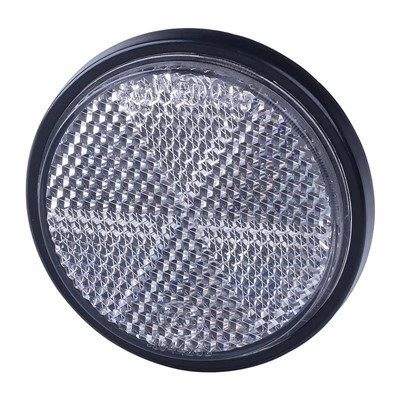
First, let’s start with the basics: what is a road reflector? At its core, a road reflector is a simple, passive device that bounces light back to its source. For our purposes as a supplier, these are usually small, flat or slightly raised markers embedded in or placed on the asphalt or concrete road surface. Most are made from durable materials like aluminum, tempered glass, or hard plastic, with a reflective coating on one side. When a car’s headlights hit that coating, the light bounces straight back to the driver’s eyes, making the marker visible even in total darkness. Road reflectors serve a wide range of purposes: they mark lane edges, center lines, fog lines, or the boundary of a work zone. They’re low-cost, easy to install, and don’t require electricity—making them a go-to for both urban and rural roads.
Now, what are cat eyes? The term “cat eyes” actually comes from a specific brand of road safety device invented in the UK in the 1930s by Percy Shaw. Shaw noticed that the eyes of cats reflected light back at him when he was driving at night, and he set out to create a road marker that worked the same way. The original cat eyes were not flat; they were small, embedded road markers with two glass prisms that acted like eyes, mounted in a rubber or metal housing set into the road surface. Unlike basic road reflectors, early cat eyes were designed to be durable enough to be driven over repeatedly, and they also had a “retroreflective” design that was more efficient than simple flat reflectors. Over time, the term “cat eyes” has become a common nickname for any embedded road marker, but technically, it refers to that specific historical design.
So, are they the same? The short answer is no, but the confusion comes from how widely the term “cat eyes” has spread. Let’s dive into the key differences that matter for anyone purchasing road safety devices. First, design and structure: basic road reflectors are often thin, flat, or slightly raised disks with a single reflective surface. They’re typically used for temporary or permanent marking where you need a low-profile marker that doesn’t disrupt tires. Cat eyes, by contrast, are usually bulkier, with a two-part housing—one part embedded in the road, and the small reflective “eyes” sitting slightly above the surface. This design makes them more visible from a distance, but they can also cause minor tire wear if they’re not installed flush, which is why many modern road crews opt for flat road reflectors on high-traffic roads.
Next, retroreflective technology. While both devices use retroreflection (bouncing light back to its source), the efficiency varies. Basic flat road reflectors often use a lens or a coating that reflects light in a wide but slightly less precise way, good for close-range visibility. Cat eyes, especially newer models, use cube-corner retroreflectors—tiny, angled prisms that bounce light straight back no matter the angle of the headlights. This means a driver can see a cat eye marker even if they’re coming from a slightly off-angle, which is why they’re often used on sharp curves or hills where visibility is limited. That said, modern road reflectors have caught up here; many high-quality road reflectors we supply now use cube-corner technology too, narrowing that gap.
Durability and maintenance are another big factor. Cat eyes, with their exposed prisms and bulkier housing, can be more prone to damage from heavy trucks, snow plows, or road debris. If a prism breaks, the marker becomes useless, and replacing a damaged cat eye requires digging into the road surface to remove the housing. Road reflectors, on the other hand, are often made with shatter-resistant coatings and a lower profile, so they’re less likely to get knocked loose. They’re also easier to replace: if a reflector is damaged, you can simply pull it up (if it’s a snap-in design) or replace the top layer without digging into the road. That’s a big reason why many municipal road departments prefer road reflectors for high-traffic areas where maintenance costs add up quickly.
Use cases also set the two apart. Road reflectors are versatile: you’ll find them marking bike lanes, crosswalks, work zones, and the edge of private driveways, in addition to standard highway lanes. They’re available in different colors (white, yellow, red, blue) to match road marking rules, and some are designed for temporary use, like on construction sites, where they can be removed once the work is done. Cat eyes, historically, were used on high-speed, rural roads with minimal lighting, but today the term is sometimes used for larger, more visible markers used on center lines or bridge approaches. That’s not to say you can’t use road reflectors for those purposes—we supply many road reflectors that work just as well for high-speed roads— but their design makes them better suited for applications where low profile and easy maintenance are key.
I’ve seen this confusion play out first-hand in my work. Last year, a construction manager from a small town reached out to me asking for “cat eyes” to mark a new stretch of rural highway. When I asked for more details, it turned out he wanted small, flat markers that could be installed quickly on a paved road, not the bulkier embedded cat eyes he’d seen on old UK highways. We supplied our high-tensile road reflectors, and he told me later that they held up perfectly through a winter of snow plows and heavy truck traffic, with no maintenance needed in the first six months. If I’d sent him standard cat eyes, he would have had to spend twice as much on installation and replacements because the bulkier markers were getting damaged by plows. That’s exactly why understanding the difference matters: it’s not just a name, it’s a practical choice that affects your budget and safety.
Another common mix-up is between road reflectors and raised pavement markers (RPMs)—which is another term people often use interchangeably with cat eyes. For the record, RPMs are a broader category that includes both road reflectors and cat eyes. Road reflectors are a type of RPM, while cat eyes are a specific sub-type within that category. That’s why you’ll see different labels depending on who you talk to: a traffic engineer might refer to a “reflective pavement marker” while a construction worker calls it a “cat eye,” but they’re often describing the same device.
So, when should you use which? If you’re marking a temporary construction zone, a bike lane, or a low-traffic street where maintenance is a priority, road reflectors are almost always the better choice. They’re cheaper upfront, easy to install, and less likely to cause issues with tire damage. If you’re working on a high-speed rural highway with limited lighting, and you need extra visibility on sharp curves or hills, a newer cat eye or a high-performance retroreflector (which we supply) might be a better fit. The key is to look at the design, not just the name—ask yourself: do I need a low-profile marker that’s easy to replace, or a more visible marker that can withstand heavy wear?
At the end of the day, the most important thing is that road safety devices work. Whether you call them road reflectors, cat eyes, or pavement markers, their job is to keep drivers, cyclists, and pedestrians safe by providing clear, consistent guidance when visibility is low. For my team, that means we don’t get hung up on the name—we focus on making high-quality road reflectors that meet the needs of our customers, whatever they call them. If you’re planning a road project, whether it’s a small residential street or a major highway expansion, and you’re not sure which device is right for you, don’t hesitate to reach out. We can walk you through the options, talk about installation requirements, and help you choose the best solution for your budget and safety goals.

Road safety is too important to get tripped up by a name. Let’s connect to discuss your project needs and find the right road safety devices for you.
Bicycle Tail Reflector References
- Federal Highway Administration. "Roadway Marking and Pavement Marking Guidelines." U.S. Department of Transportation, 2021.
- Shaw, P. "The Invention of Cat’s Eyes: A Memoir of Road Safety Innovation." UK Road Safety Journal, vol. 12, no. 3, 1965, pp. 45-52.
- American Association of State Highway and Transportation Officials. "Standard Specifications for Retroreflective Pavement Markers." AASHTO, 2022.
- Smith, J. "Durability Comparison of Road Reflectors vs. Embedded Pavement Markers." Journal of Transportation Engineering, vol. 148, no. 7, 2022, pp. 04022038.
Ningbo Baixuejia Reflector Co., Ltd.
Ningbo Baixuejia Reflector Co., Ltd. is one of the most professional road reflector manufacturers and suppliers in China. We are committed to providing high quality automotive parts and reflective safety products with competitive price. Please feel free to wholesale advanced road reflector made in China here from our factory. Also, quotation is available.
Address: No.10-12, Southwest Road, Shidong Village, Guanhaiwei Town, Cixi City, Zhejiang Province
E-mail: bxjreflector@cnbxj.cn
WebSite: https://www.bxjreflector.com/
