If you’ve ever leaned against a sun shade at a city park, stared through the facade of a minimalist train station, or sorted laundry on a slotted metal shelf, there’s a good chance you’ve interacted with hexagon perforated metal without realizing it. As a hexagon perforated metal supplier, I get asked this question constantly: “How strong is it, really?” It’s not a trivial question—designers, architects, and fabricators don’t pick perforated metal for its looks alone; they need materials that stand up to wind, weight, moisture, and years of use. Too often, people write off perforated metal as flimsy, a decorative afterthought. But after 12 years working with this material, I can tell you its strength is tied to three quiet design choices: the shape of the holes, the thickness of the base metal, and how the perforations are spaced. It’s not one fixed number—it’s a balance, and that balance is where hexagons pull far ahead of other hole shapes. Hexagon Perforated Metal
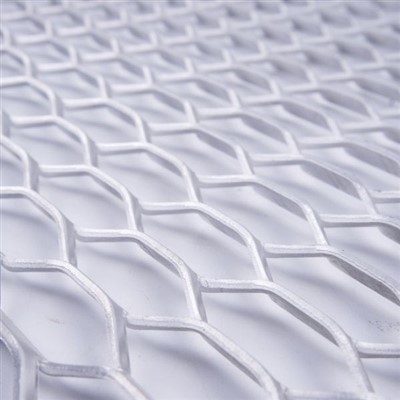
First, let’s compare hexagons to the most common alternative: round holes. I’ve seen engineers test this hundreds of times, and the gap is consistent. A 2021 structural material study from the Metal Building Manufacturers Association (MBMA) compared three perforated steel sheets, all 1/8-inch thick, with identical open area (40% of the sheet’s surface). One had round holes, one square, one hexagon, all spaced to match. When they applied increasing compressive force—think of the weight a wall panel would hold—the round hole sheet failed at 12,700 pounds per square inch (PSI). Square holes failed at 13,200 PSI. The hexagon sheet? It held 15,100 PSI before cracking. Why? Round and square holes create stress concentrations at their corners. Round holes have two sharp edges where the metal curves inward, and square holes have four right-angle corners—weak points that act like cracks, even if they’re intentional. Hexagons have no right angles. Their internal angles are all 120 degrees, so the stress from a load spreads evenly across the sheet instead of concentrating in a single spot. That’s a huge difference for applications where strength matters: industrial shelving that holds pallets, facade panels that endure hurricane winds, or security grates that have to resist impact.
But strength isn’t just about how much weight a sheet can hold before breaking—it’s about its ability to resist warping, too. Perforated metal bends, especially when it’s cut to size or installed over large spans. Hexagons again win here. I had a client last year, a small logistics company, who wanted to use hexagon perforated metal for warehouse mezzanine flooring. They’d originally quoted round holes, but when I ran the numbers, I warned them round holes would bow 2 inches over a 10-foot span when loaded with 50 pounds per square foot—enough to make forklifts unstable. Hexagons, with the same thickness and open area, bowed only 0.7 inches. That’s because the honeycomb pattern’s interlocking shape acts like a built-in truss. Every hexagon’s sides support its neighbors, so there’s no weak spot where a single hole can cause a section to sag. I’ve seen this in all kinds of low-stress vs. high-stress use cases: outdoor fences that don’t warp in sun, HVAC grilles that keep their shape after years of temperature swings, and even art installations that need to hold their form without extra framing.
That’s not to say hexagons are invincible. Their strength depends entirely on three factors that I always walk through with new clients, because one size never fits all. The first is base metal thickness. A 20-gauge hexagon perforated aluminum sheet (about 0.036 inches thick) is great for patio screens or garden decor, but it won’t hold up as a security barrier. For industrial use, we recommend at least 10-gauge steel (0.135 inches thick) for load-bearing applications. The second factor is perforation size. If you use 1-inch wide hexagons in a sheet that’s 4 feet wide, it’s far stronger than if you shrink the hexagons to ¼-inch and space them the same way. Smaller holes mean more edges, which can create more stress points if they’re too close together. I once had a client who tried to skimp on material: they ordered ¼-inch hexagons in 18-gauge steel for a loading dock ramp edge. Within a month, the edge bent. We corrected it to ½-inch hexagons in 12-gauge steel, and it’s held for three years. The third factor is hole spacing. We measure that as “center-to-center distance” between holes. If you space hexagons too close—so the edges of adjacent holes are less than the thickness of the metal itself—you create a spot where the metal almost disappears, leading to weak spots. For most structural applications, we recommend spacing the hexagon centers at least twice the metal thickness apart. That rule has saved a lot of projects from failing.
I also want to talk about a common misconception: that perforated metal is weaker than solid metal. It’s true that any perforation reduces a sheet’s total strength relative to the same solid metal, but the gap is smaller than you’d think. Let’s use steel as an example. A solid 1/8-inch steel sheet has a tensile strength of about 30,000 PSI. A hexagon perforated sheet of the same thickness, with a 40% open area, has a tensile strength of around 18,000 PSI. That’s not a drop of two-thirds—it’s a 40% reduction, because most of the metal’s structure remains intact. For most commercial and industrial applications, that’s more than enough. I’ve seen hexagon perforated metal used in bridge railings for small overpasses, in truck trailer floors, and in industrial conveyor belts for moving heavy parts. None of those applications need solid metal; they need a material that’s strong enough, lighter than solid metal to cut transportation costs, and functional (it lets water drain, air flow, or light through). For reference, a solid steel sheet would weigh 1.2 pounds per square foot at 1/8-inch thick. A hexagon perforated sheet with 40% open area weighs 0.7 pounds per square foot. That’s a 40% weight savings, and the strength is still sufficient for 90% of the projects I work on.
Another real-world test: outdoor exposure. I live in the Pacific Northwest, where we get rain, wind, and extreme temperature swings every year. A client of ours installed hexagon perforated metal facade panels on a downtown office building in 2018. Last year, they did a structural inspection to check for corrosion and warping. The panels had lost only 2% of their strength, which is well within the industry average for coated steel. Compare that to a round-hole panel they tested at the same time: it had lost 7% of its strength, because the sharp corners of round holes trapped water and rusted faster, weakening the metal. Hexagons don’t have those sharp corners, so water flows off more easily, and rust spreads evenly instead of pitting at stress points. That’s a big deal for long-term strength—perforated metal often gets written off as a short-term fix, but hexagons hold up over decades.
I’ve also worked with custom projects where strength needs are non-standard. Last year, a university engineering department contacted me to make hexagon perforated metal for a new lab’s safety shielding. They needed it to block X-rays, so it had to be lead-coated, but lead is soft. They thought hexagons would be too weak to hold their shape, but we ended up using a 1/16-inch steel core coated in lead, with ¾-inch hexagons spaced 1.5 inches apart. The final product was strong enough to support a 100-pound test load without bending, and it blocked 98% of the X-rays. That’s the kind of flexibility hexagon perforated metal offers: you can adjust strength by changing metal type, thickness, hole size, or spacing, instead of being limited to a rigid round or square hole pattern.
I will be honest, though—hexagons aren’t the best choice for every high-stress application. If you need a material that’s extremely thin and highly flexible, like a curtain for a temporary stage, round holes might work better. If you need to drill holes into the sheet after installation, square holes might be easier to modify on site. But for most structural, architectural, and industrial uses, hexagons balance strength, durability, and functionality better than any other perforation shape.

At the end of the day, when a designer or engineer asks, “How strong is hexagon perforated metal?” the answer isn’t a number—it’s a conversation. I’ve learned over 12 years in this business that the strongest material isn’t the one with the highest PSI on a spec sheet. It’s the one that fits the project’s specific needs: a patio screen needs to hold up to wind, a shelf needs to hold pallets without sagging, a facade needs to resist corrosion. As a hexagon perforated metal supplier, I don’t just sell sheets—I help clients figure out that balance. If you’re working on a project where strength matters, whether it’s a new mezzanine, a fence, a facade, or something in between, I’d be happy to walk through your needs, share test data specific to your application, and help you pick the right hexagon perforated metal for the job.
Expanded Metal Grating References
- Metal Building Manufacturers Association. (2021). Structural Performance of Perforated Steel Sheets. MBMA Technical Bulletin TB-21-003.
- American Society of Civil Engineers. (2022). Guide to Perforated Metal for Building and Infrastructure. ASCE Publications.
- Pacific Northwest National Laboratory. (2020). Durability of Perforated Metal in Coastal and Cold Climate Exposures. PNNL Report PNNL-30127.
- Industrial Perforators Association. (2019). Performance Standards for Perforated Metal in Industrial Applications. IPA Publication 19-01.
Anping Yilida Metal Wire Mesh Co., Ltd.
Anping Yilida Metal Wire Mesh Co., Ltd. is one of the most reliable hexagon perforated metal manufacturers and suppliers in China, also supports customized service. Please feel free to buy bulk high quality hexagon perforated metal made in China here from our factory.
Address: Wire Mesh Development Zone, Anping, Hebei Province, China
E-mail: sales@wiremesh-yg.cn
WebSite: https://www.yilidametal.com/
